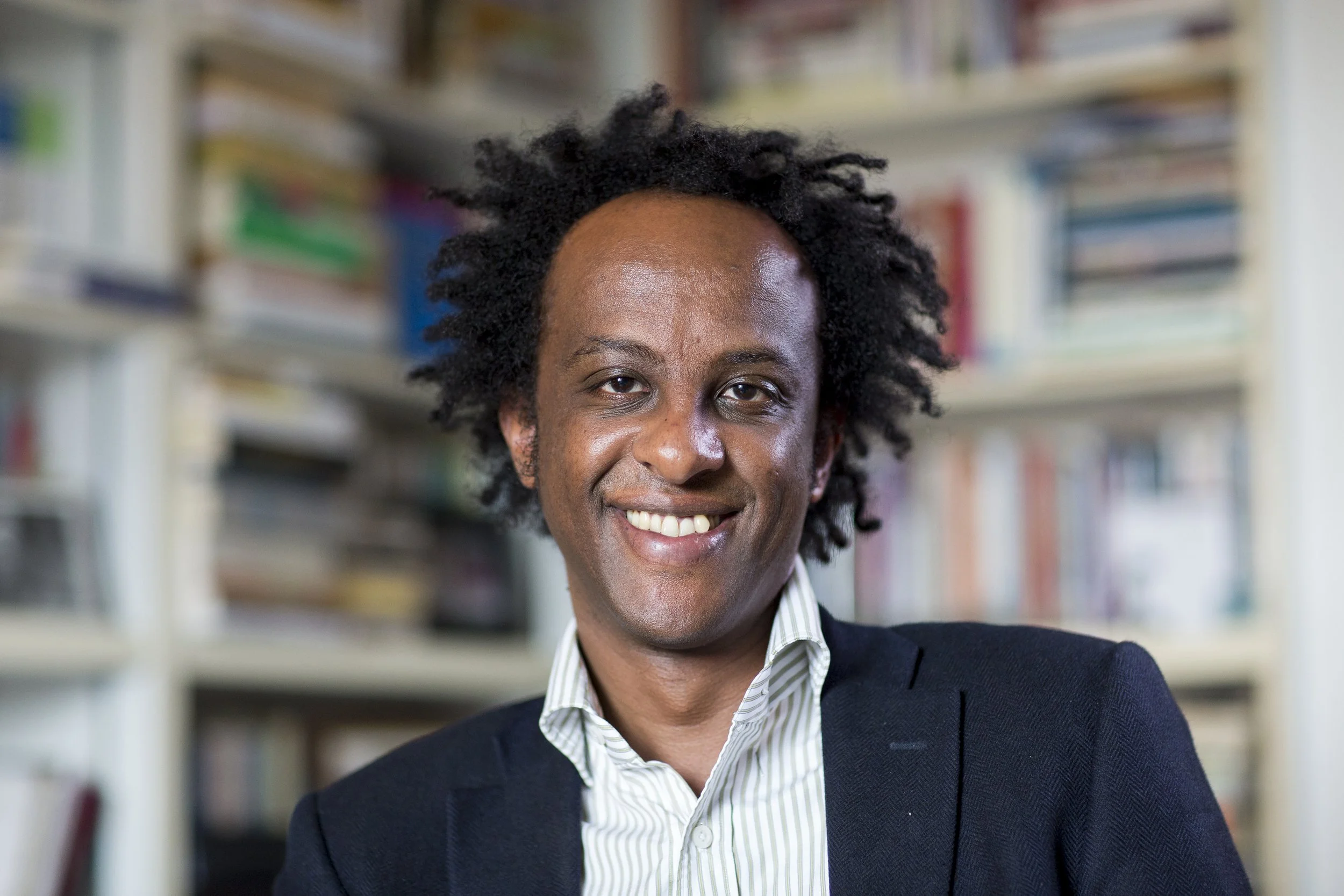
Dinaw Mengestu at Georgetown University in 2012. Portrait courtesy of the John D. and Catherine T. MacArthur Foundation.
A quarter century after leaving Ethiopia, Dinaw Mengestu returned to Addis Ababa and slept in the bedroom where his mother, his sister and his two year old self had once lived. The room belonged to a life he could not remember. When he left again, one aunt wept at the airport. Another relative explained the grief: people leave promising to return, then stay away for ten or twenty years. To those who remain, the absence can feel almost like a death.
Mengestu had spent his life inside that distance. He was born in Addis Ababa in 1978, after his father had already fled the violence of Ethiopia's revolution. Two years later, his mother secured visas for herself, Dinaw and his sister. They joined his father in Peoria, Illinois, where he had found work at Caterpillar and the family became part of a Southern Baptist church.
The move gave the family safety, but it did not make the past easy to name. Mengestu has said that his parents worked long hours to build a home and raise their children. Inside that home, Ethiopia remained present in food, language and memory. Outside it, he was an American child in a small Midwestern city. The country he had left was offered to Americans mostly through images of famine. His parents carried something more complicated: memories of beauty, violence, family and loss.
At the center of that loss was Mengestu's uncle, a lawyer who had been taken from his office during Ethiopia's Red Terror. He died in prison after a beating. For years, the family barely spoke about what had happened. When the story finally emerged, Mengestu wanted to preserve it. The silence did not produce a memoir. It opened a door into fiction.
After graduating from Georgetown University in 2000, Mengestu earned a master of fine arts degree from Columbia University in 2005. He also reported from Darfur, northern Uganda and eastern Congo. The work placed him near wars whose public language could flatten lives into numbers. Fiction gave him another way to hold what exile does slowly: how it changes a marriage, a neighborhood, a memory and the stories parents can pass to their children.
His first novel, The Beautiful Things That Heaven Bears, appeared in 2007. Its Ethiopian shopkeeper lives in Washington, D.C., among other immigrants who recall African coups while watching a changing American neighborhood press against the door. The novel was an American story, Mengestu insisted, even as readers sometimes tried to confine him to the label of Ethiopian writer.
Three more novels followed: How to Read the Air, All Our Names and Someone Like Us. Each returned to the unstable ground between departure and belonging, but from a different angle. All four were named notable books by The New York Times. In 2012, the MacArthur Foundation awarded Mengestu a fellowship, recognizing a body of work that had made displacement intimate without making it simple.
Mengestu joined Bard College in 2016. He is now the John D. and Catherine T. MacArthur Professor of Humanities and directs the Written Arts Program, where his public contribution continues through teaching as well as books. He helps new writers examine the worlds they inherited, including the silences inside them.
His journey does not offer return as a tidy answer. The childhood room in Addis Ababa could not give back the years between leaving and coming home. But it held the shape of what had been missing. Mengestu has spent his career making room for that shape on the page, so that absence is not mistaken for emptiness and the people who leave are not lost a second time.