The Letter That Belonged to Five People
By Mukurima Muriuki,
The story of Elizabeth-Faith Njambi Ngechu
The email arrived on a Thursday afternoon, the way most of these emails do; no fanfare, no warning, just a subject line sitting quietly in an inbox like a held breath. Elizabeth-Faith Njambi Ngechu had trained herself not to hope too hard. She had been waitlisted by UCLA, and anyone who has refreshed an admissions portal at 11 p.m. knows the particular discipline it takes to protect your heart from your own imagination. You learn to prepare for the version of the story that doesn't end the way you wanted it to.
Then she opened the email, and it did.
The celebration that followed didn't belong to her alone. It belonged to her parents, who had crossed an ocean decades earlier carrying little more than the conviction that a future worth having was somewhere on the other side of it. It belonged to her younger brother, Noah, whose own fragile entry into the world would, without either of them knowing it at the time, help write the next chapter of hers. It even belonged to a grandmother in Kenya, half a world and eight time zones away, whose name Elizabeth had carried since birth, long before she understood the weight tucked inside it.
The letter bore one name. It told the story of an entire family.
Elizabeth's full name: Elizabeth-Faith Njambi Ngechu, reads like a map of where she comes from. "Faith" honors her grandmother, Mary Faith. "Njambi" plants her firmly in Kenyan soil, the country her parents left not long after finishing high school, chasing opportunities they had come to believe simply didn't exist for them at home. They traded the familiar for the uncertain: parents, siblings, decades-old friendships, the quiet comfort of knowing exactly where you belong in a room. Like so many before them, they boarded a plane on the theory that if their own lives got harder, their children's lives might get easier.
That theory eventually found an address in Eastvale, California, a fast-growing suburb of tract homes and strip malls east of Los Angeles, the kind of place where Elizabeth grew up sounding, unmistakably, like a Southern California kid.
She laughs like one. She talks like one. And she has never once felt the need to choose between being American and being Kenyan, because in her house, she never had to. California shaped her perspectives, how she talks and the rhythm of her school days; Kenya lived quietly inside the walls of her home, in the food on the stove, in the traditions her parents refused to let thin out with distance, in stories that had crossed continents long before she ever boarded a plane herself.
Outside those walls came the questions every child of immigrants eventually learns by heart.
How do you pronounce your name?
Where is your family really from?
For Elizabeth, she never heard those questions as a verdict on where she belonged. If anything, they reminded her she was carrying something rare.
"I never saw being different as a bad thing," she says. "At home, surrounded by my family and our culture, I always felt completely comfortable being myself."
As a child, Elizabeth didn't fully register what her parents had given up to build the life she was living. Few children do. What they see instead are mothers and fathers who go to work, who pay bills, who insist that homework comes before nearly everything else, the visible machinery of a household, not the invisible cost of running it. It isn't until adulthood, usually, that the routine reveals itself for what it actually was.
Her mother, Patricia, built a career as an accountant. Her father, Ngechu, became a computer engineer. They worked hard, and somehow, in the middle of that work, they made sure their children never once doubted where they stood on the list of priorities. Looking back now, Elizabeth understands that when her parents pushed her to take school seriously, they weren't chasing grades for their own sake. They were guarding a door they had crossed an ocean to open.
"I thought they were just strict," she says, smiling at the memory. "Now I understand they wanted me to have opportunities they never had."
Ask Patricia what she's proudest of, and she doesn't lead with UCLA, or the honors, or the recognition that made Elizabeth one of Riverside County's standout students. She leads with character. She describes a daughter who became the glue holding the family together; a self-confessed daddy's girl, her mother's late-night sidekick, and a fiercely protective older sister to her brothers. She speaks, in particular, about Elizabeth's drive to show young girls, and especially young Black girls, that they belong in science, technology, engineering and mathematics- rooms where they are so often told, in ways loud and quiet, that they don't.
Then Patricia says something that stops the conversation cold.
"If I could go back in time," she says, "I would want to be like her."
There are not many higher compliments a mother can offer her child.
Ngechu, her father sees the same daughter, through a different lens.
"What I am most proud of is her drive and tenacity," he says. "Njambi is resilient and unwavering when she wants to achieve something, whether in academics or any other area of her life."
He raised his children on a saying that eventually became part of the family's shared vocabulary, repeated so often it stopped sounding like advice and started sounding like fact:
"Hard work does not guarantee success, but without hard work you are guaranteed to fail."
He believed in structure, in consistency, in parents who were simply, reliably present. He encouraged his daughter to dream without a ceiling on it, while reminding her that perseverance would matter as much as talent, maybe more. And he made a point of putting names in front of her that could stretch her sense of what was possible, among them the Nobel Peace Prize laureate Wangari Maathai and the celebrated Kenyan novelist Grace Ogot. Elizabeth couldn't have fully appreciated those introductions as a child. That wasn't really the point. Her father wanted her to grow up understanding that brilliance wasn't something you admired from a distance. It was something you were allowed to reach for yourself.
High school became a study in balance: Advanced Placement classes stacked against leadership roles, scientific research, volunteer hours, and the slow-building weight of college applications. From the outside, people saw the accomplishments piling up. What they didn't see were the quieter moments in between: the nights she wondered if she was doing enough, or whether she could really keep every plate spinning at once.
Resilience, she has come to understand, is rarely built in the moments anyone applauds. It's built in the ones nobody sees at all.
One of the people who helped steady her through those years was Dr. Auld, the first Black science teacher Elizabeth ever had. Representation is a word thrown around so often it can start to feel abstract, but for Elizabeth it became something specific and personal. Watching someone who looked like her lead a science classroom made the idea of becoming a physician feel less like a fantasy borrowed from television and more like a future she could actually walk toward. Dr. Auld opened the door to research, fed her curiosity, and maybe without even meaning to, helped turn ambition into something sturdier: belief.
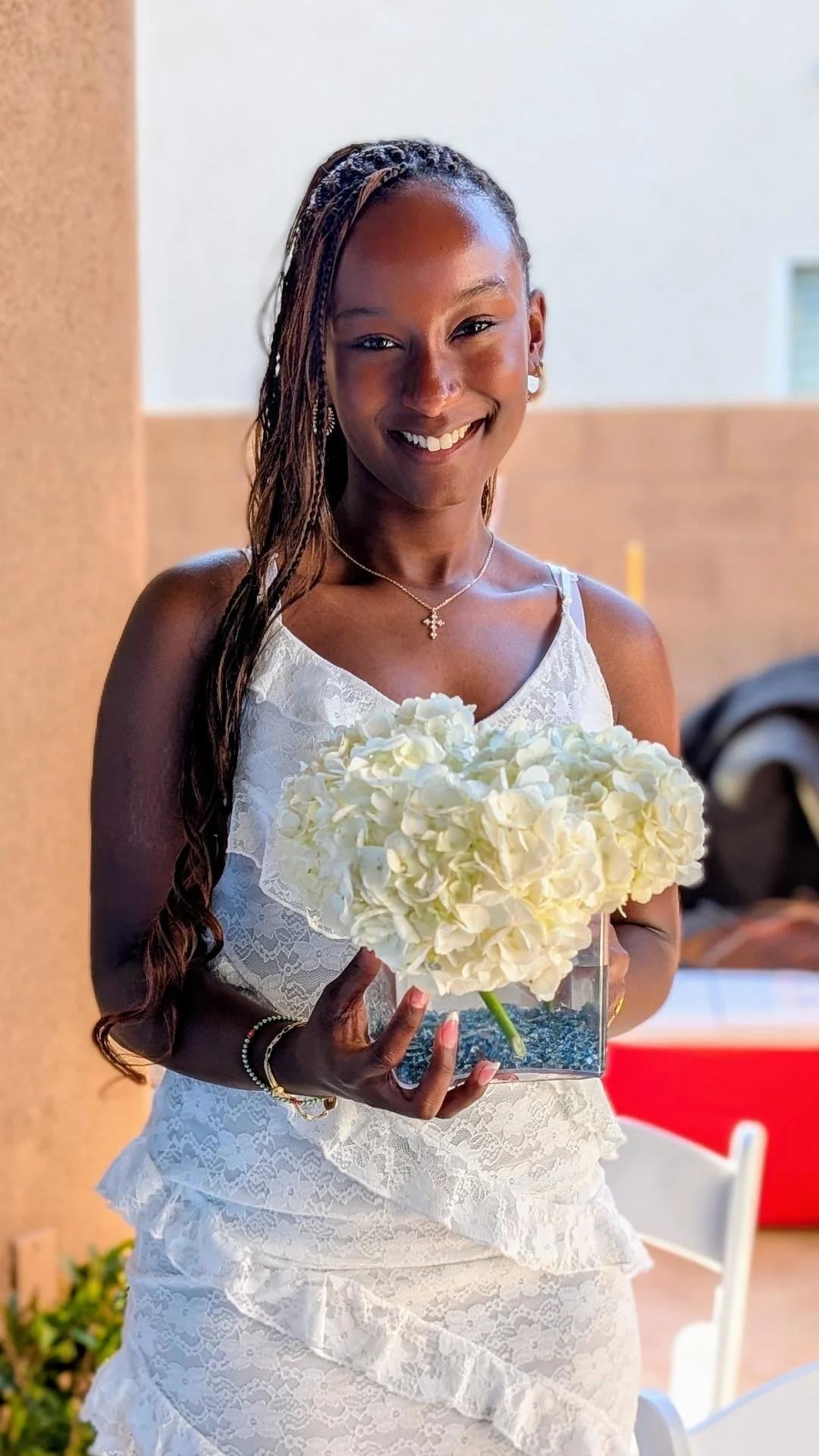
The dream itself, to go to medical school, , had started years earlier, in a hospital hallway.
Like a lot of kids, Elizabeth grew up watching Doc McStuffins. But it wasn't a cartoon that shaped her future, it was her brother. When Noah was born ten weeks premature, he spent his first weeks of life in the Neonatal Intensive Care Unit, tethered to monitors in an incubator built for a body that small. Medicine stopped being something Elizabeth admired from a distance. She watched doctors and nurses care not only for a fragile newborn, but for two terrified parents whose entire world had suddenly narrowed down to a single hospital room and the hope carried in each day's update.
It left a mark that never faded.
Today, Elizabeth hopes to become a neonatologist, caring for premature babies, and for the families standing beside their incubators the way her own parents once stood beside Noah's. For her, medicine isn't simply a career path. It's a way of returning the compassion her family once received, to another family standing exactly where hers once stood.
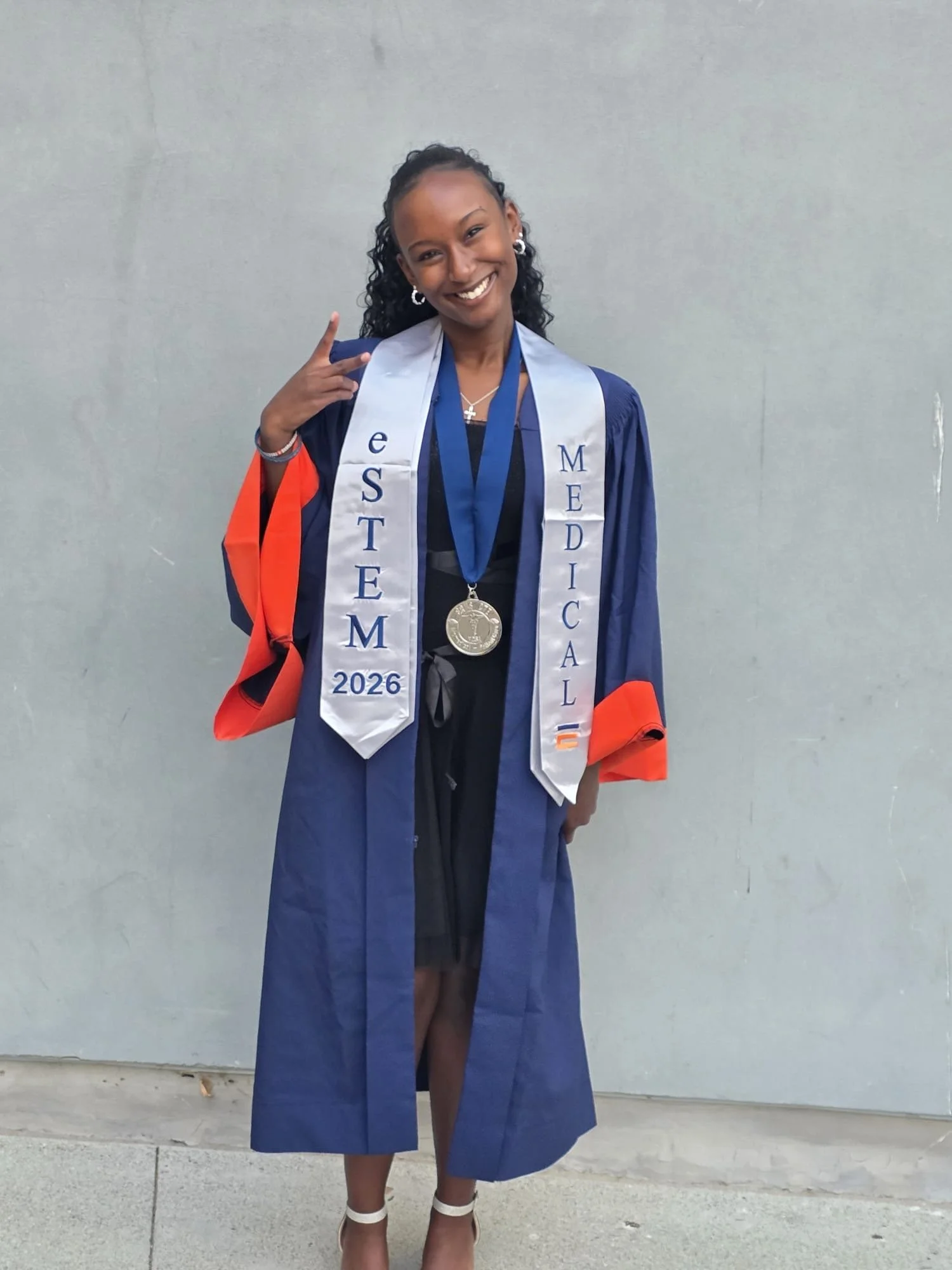
As Elizabeth crossed the High School stage in her stole, she found herself scanning the crowd for her parents. She found them easily: their pride was written across their faces in a way that didn't need translation. In that moment, she understood the diploma in her hands wasn't really about her at all, or wasn't only about her. It was proof that the sacrifices made years before, on the other side of an ocean, had not been made in vain.
It was also the culmination of a remarkable run. Elizabeth graduated as one of Riverside County's most accomplished students, recognized not just for academic excellence but for leadership, research, service, and a level of commitment to her community that outpaced her age. For her parents, though, the honors mattered less than the young woman standing underneath them.
Perhaps the real secret was in the moments no one else ever saw.
Most nights, before bed, Patricia would quietly slip into her daughter's room.
"We gossip," she says, laughing.
Elizabeth talks about her day, the worries, the small victories, sometimes nothing in particular at all. Patricia mostly listens. Looking back, she considers those unremarkable, unhurried conversations one of the greatest gifts she ever gave her daughter. They built trust in small, daily deposits. They created a space where honesty didn't require bravery. They reminded Elizabeth that no matter how demanding life became, there would always be one room in the world where she could say anything and know, without question, that she'd be heard.
Before we finished talking, I asked Elizabeth what she hoped another daughter of immigrants might take from her story.
She offered something that made me pause:
"You never have to choose between your culture and your dreams," she said. "Your background isn't something that holds you back. It's something that makes your story unique, and it can become one of your biggest strengths."
Perhaps that's the real story here.
The real story is that somewhere between Kenya and California, between sacrifice and opportunity, between heritage and hope, a young woman discovered she never had to choose between the two worlds that raised her. She could carry both, at once, with equal pride: One gave her roots. The other gave her room to grow.
And somewhere along the way, a little girl became the kind of woman her mother quietly says she wishes she could have been herself.
Some dreams begin with an acceptance letter.
The greatest ones begin with parents who dared to dream long before their children ever could.
May the day break.