How I Use AI to Trade US Stock Market
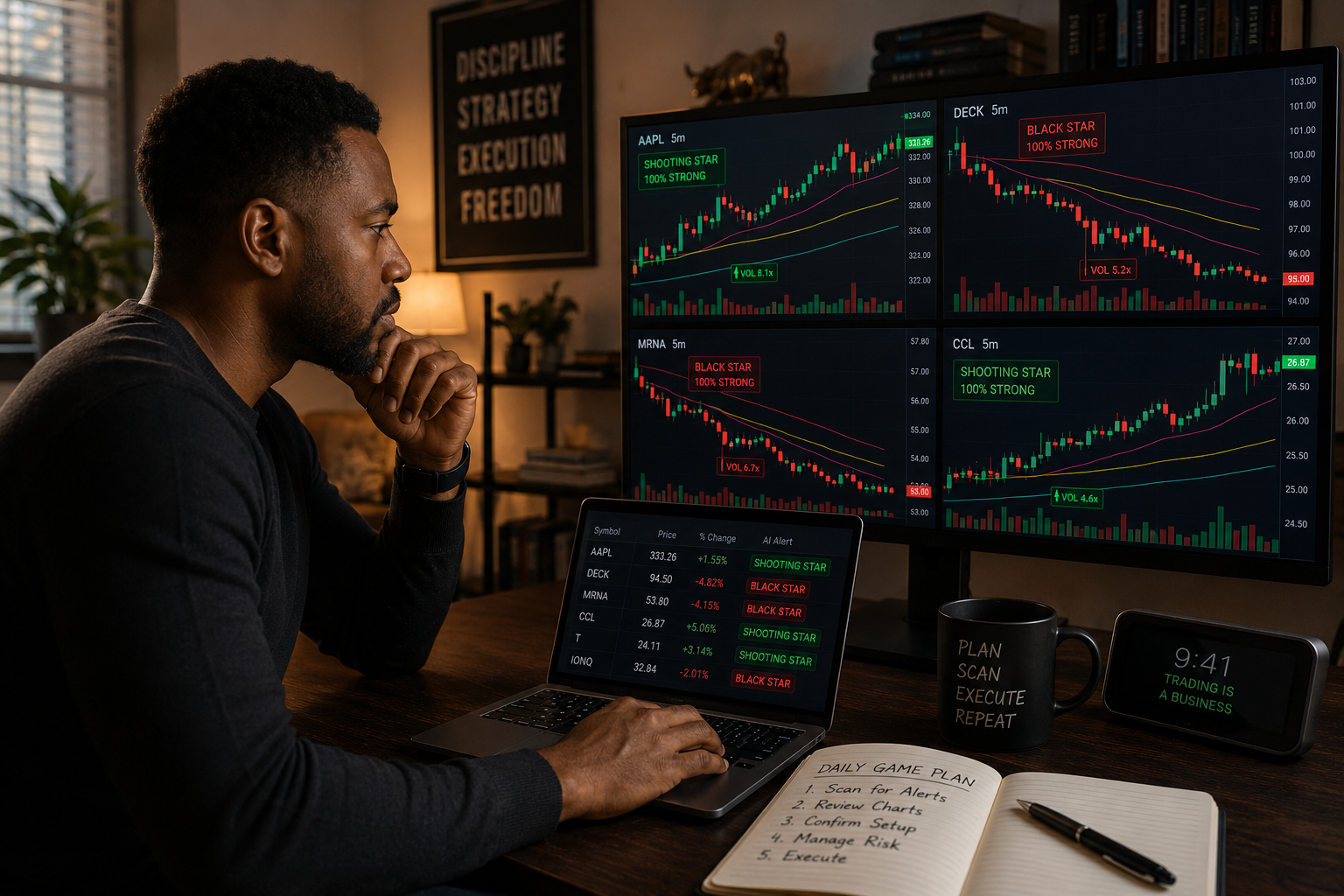
Most people are using AI to write emails, summarize documents and create pictures.
I decided to teach mine how I trade in the US Stock market.
Over the past several months, I have been building and refining a system designed to do something very specific: watch the market the way I would, only faster and without getting tired.
Every trading day, thousands of candles are forming across hundreds of stocks. Volume is changing. Momentum is shifting. Buyers and sellers are fighting around key price levels. Most of it is noise.
But every once in a while, several things happen at the same time.
That is what I'm looking for.
My system analyzes market activity in real time and looks for unusual combinations that may signal that a stock is about to make a significant move. When enough of those conditions line up, I get an alert.
Then I make the decision.
Think of it as having someone sitting beside you watching dozens of charts simultaneously and saying:
"Hey…you might want to look at this one."
On Friday the 24th of July, I received six alerts on my phone the system identified were worth a look.
If I had acted when the alert appeared, this is what would have have happened:
DECK: approximately 6.8%
CCL: approximately 5.5%
MRNA: approximately 4.8%
AAPL: approximately 3.5%
AT&T: approximately 3.4%
IONQ: approximately 2.1%
These are movements in the stock itself, not option returns.
And that is where things get interesting.
A 3%, 5% or 6% move in a stock can create a very different percentage move in an options contract, depending on the strike, expiration, volatility and timing.
Of course, no indicator predicts the future. A great setup can fail tomorrow, and past results don't guarantee future returns. Risk management still matters enormously.
But AI has changed one part of trading for me:
I no longer have to find every opportunity with my eyes.
Instead of staring at 30 charts hoping I notice something, this system helps separate ordinary market activity from moments that deserve my attention.
And perhaps the biggest lesson I have learned is not that AI can replace a trader.
It cannot.
The real power comes from combining human judgment with machine speed.
So what exactly do my AI alerts tell me?
The system does not simply tell me BUY or SELL. Different alerts tell me different things about what may be happening in a stock.
Shooting Star: My bullish directional signal. The system is seeing the kind of alignment I want when buyers appear to be taking control.
Black Star: The bearish counterpart. It identifies the kind of alignment I look for when sellers appear to be taking control.
Monster: Something powerful is developing from a Shooting Star or Black Star. Several conditions I care about are aligning strongly in one direction. When Monster appears, the stock has my attention.
Full Ignition: The (Monster) move is accelerating. What the system was detecting earlier is beginning to translate into real price action.
And then there is Money Alert.
This one has a very different meaning for me.
Money Alert is getting in with both feet.
By the time this alert fires, the system is detecting an extraordinary level of activity. This isn't “put this stock on the watchlist.” It's the system screaming that something significant is happening right now.
Over the next few weeks, I am going to start sharing more about how I use AI in my trading, how I evaluate an alert, what I look for before entering an options trade, and how someone without a programming background can begin thinking about AI as a trading assistant.