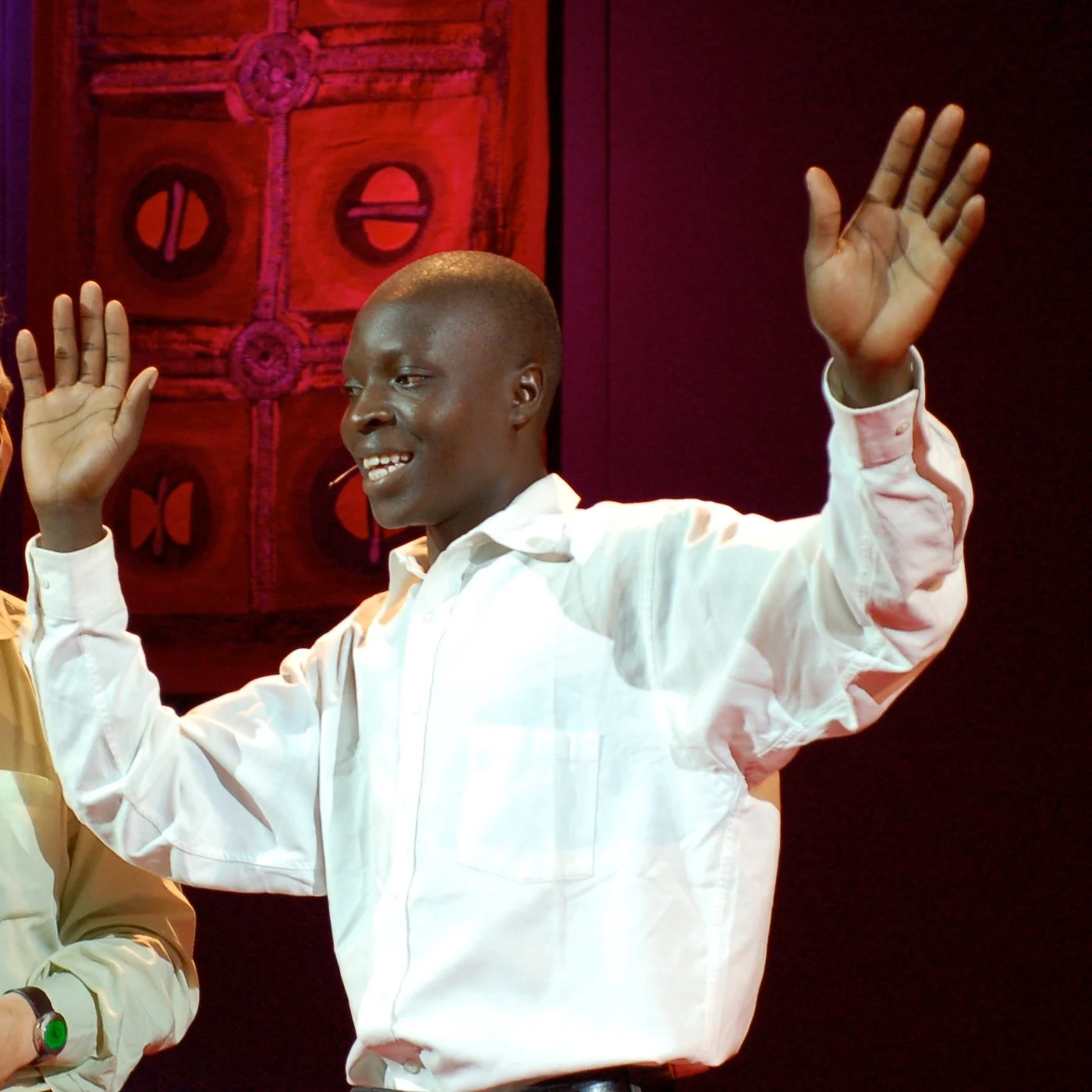
Photo: Erik (HASH) Hersman / TED 2007. CC BY 2.0. Cropped.
William Kamkwamba was 14 when the school fees became impossible. Malawi was in famine, his farming family had little money, and the classroom door closed. But in the small library near his village of Wimbe, he found an American textbook called Using Energy. English was still difficult for him. The picture of a wind turbine was not.
There were no instructions he could follow home, no machine shop and no catalogue of new parts. Kamkwamba studied the diagram and began making his own calculations. From a broken bicycle, a tractor fan, plastic pipe, bamboo and wire, he assembled a windmill tall enough to catch the air above his family’s fields. It produced electricity for lights and radios in a home that had known darkness after sunset.
The machine began as an answer to an immediate problem, not as a performance of genius. Kamkwamba had grown up on his family’s farm in Masitala Village, outside Wimbe in central Malawi. During the 2001 to 2002 famine, his family could not afford the annual school fees. He was out of formal education for years, yet he kept borrowing books and teaching himself. The windmill made visible what the fee ledger could not measure: the child excluded from school was still learning.
News of the invention moved beyond the village. A Malawian newspaper and a technology blog carried his story, and TEDGlobal conference director Emeka Okafor eventually tracked him down and invited him to speak in Arusha, Tanzania. The attention helped Kamkwamba return to school. He studied in Lilongwe and later at the African Leadership Academy in Johannesburg, a passage from solitary experiments to classrooms filled with other young people trying to solve problems across the continent.
America entered the journey through education. On a 2009 book tour for The Boy Who Harnessed the Wind, the memoir he wrote with journalist Bryan Mealer, Kamkwamba visited Dartmouth College. He was drawn to its hands on engineering program and to the fact that undergraduates could use the machine shop early. He enrolled in 2010, an unusually public freshman whose windmill, TED talks and book were already known around the world.
Dartmouth gave him instruments, laboratories and a vocabulary for questions he had first met through necessity. He majored in environmental studies, minored in engineering and graduated in 2014. The move did not replace the knowledge of Wimbe with American expertise. It enlarged the range of things he could carry between them.
After college, Kamkwamba became a Global Fellow at the nonprofit design organization IDEO.org. He also worked with the WiderNet Project on curricula intended to help young people move from knowing to doing. His memoir has sold more than one million copies and appeared in nearly 20 languages; it was later adapted into a film directed by Chiwetel Ejiofor. Yet the most consequential part of his work may be less visible than the story that made him famous.
Kamkwamba now divides his time between the United States and Malawi and works with Moving Windmills, the nonprofit he co-founded. In Kasungu, the organization is developing an innovation center where young Malawians can use tools, learn from mentors and build practical responses to local agricultural and energy problems. The model is deliberately rooted in appropriate technology: materials people can find, repair and understand, joined to the knowledge already present in their communities.
His public life is often compressed into one astonishing sentence: a boy built a windmill from scrap. The fuller journey is quieter and more demanding. A famine interrupted his schooling. A library preserved his access to ideas. Institutions in Africa and America widened his choices. Then he turned those choices back toward the place where they had first been denied.
The original windmill rose because Kamkwamba could read possibility in a picture. The center taking shape in Kasungu offers a different image: a room where the next young inventor will not have to wait for a discarded diagram, or build alone in the dark.