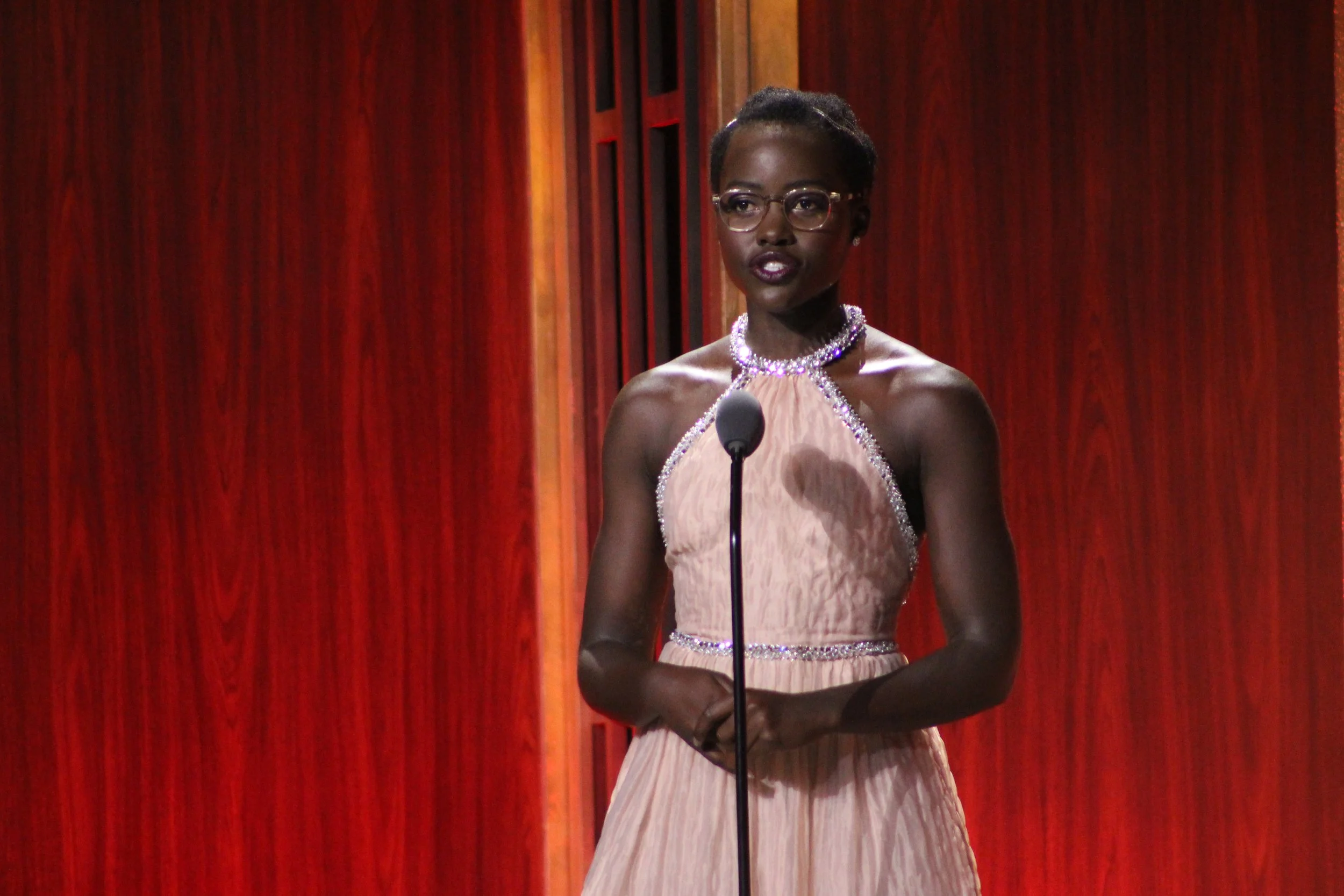
Photo by Stephanie Moreno / Grady College of Journalism and Mass Communications for Peabody Awards / University of Georgia. CC BY-SA 2.0. Cropped.
Before Hollywood knew Lupita Nyong’o, she spent eight months in Kenya pointing a camera toward people her society could not stop noticing and had learned not to see.
She was a student at Hampshire College in Massachusetts when she returned to Kenya to research and film In My Genes, a documentary about people living with albinism. Its central figure, Agnes, was a mother of seven who had lost her sight and was confronting skin cancer. Nyong’o described people with albinism in Kenya as both hyper-visible and effectively invisible. The film asked viewers to remain with that contradiction instead of looking away.
The project carried Nyong’o back toward the country that had formed her. She was born in Mexico while her father, the scholar and pro-democracy politician Peter Anyang’ Nyong’o, was living there in political exile. The family returned to Kenya shortly after her first birthday, and she grew up in Nairobi. At 16, she spent several months in Mexico learning Spanish, a language tied to the passport she already held. Then she crossed another border, coming to the United States for college.
At Hampshire, Nyong’o studied film and African studies in an academic system without conventional grades. She later recalled being nervous about that freedom. It forced students to set their own direction, and she discovered that she could turn an ambition into a plan. She worked behind the camera as a production assistant on The Constant Gardener, a post-production intern on The Namesake and an art intern on Where God Left His Shoes.
Still, In My Genes was not an easy act of confidence. Nyong’o remembered the project as a period of self-reflection and self-doubt. She credited professors Baba Hillman and Natalie Sowell with keeping faith in her when her own certainty thinned. The documentary won first prize at the 2008 Five College Film Festival, screened at Lincoln Center and secured North American distribution through Third World Newsreel. It also established a pattern that would outlast the film: when Nyong’o encountered a question about identity, beauty or belonging, she made room for a story.
After working in film and television in East Africa, she returned to the United States to train as an actor at the Yale School of Drama, earning her master’s degree in 2012. Soon afterward, director Steve McQueen cast her as Patsey in 12 Years a Slave. The role demanded that she inhabit a life brutalized by slavery without reducing Patsey to suffering alone. In 2014, Nyong’o won the Academy Award for best supporting actress.
The award opened doors, but the work that followed did not settle into one kind of success. She performed on Broadway in Danai Gurira’s Eclipsed, joined the global worlds of Star Wars and Black Panther, and played two sharply different women in Jordan Peele’s Us. In 2019, she published Sulwe, a children’s book about a dark-skinned girl who longs to be lighter. Nyong’o has said the story grew from the colorism that damaged her own self-esteem as a child. Rather than disguise the wound, she gave young readers a language for it.
Nyong’o’s journey resists the clean line often imposed on immigrant stories. America gave her classrooms, mentors and stages; Kenya remained a source of memory, responsibility and return. Mexico was not a footnote but part of her citizenship and sense of self. Her public contribution has emerged from holding those places together rather than choosing one as the whole explanation.
Long before the red carpets, there was Agnes in Kenya, weaving baskets after losing her sight, and a young filmmaker trying to make the world look long enough to understand. The camera changed hands. The question did not. Who is visible, who is valued, and what becomes possible when a story refuses to turn away?